

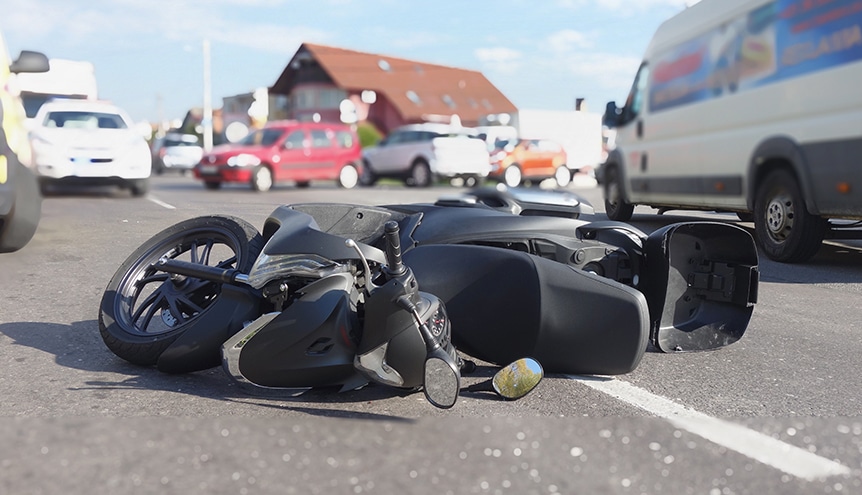
Tulsa Motorcycle Accident Lawyer
Representing riders and passengers throughout Oklahoma in injury claims
Motorcyclists are often the victims of negligent automobile drivers. When these collisions occur, they can result in serious long-term injuries or death. According to the National Highway Traffic Safety Administration, a motorcycle rider is about 28 times more likely to die in a crash than occupants of passenger vehicles.
At Biby Law Firm Injury and Accident Lawyers, our respected Tulsa motorcycle accident lawyers understand that at-fault motorists, their insurance carriers, and lawyers often try to blame motorcycle riders. They may claim that the motorcyclist was speeding, or wasn’t wearing a helmet, or wasn’t making themselves visible.
Our personal injury lawyers work aggressively to establish where fault truly lies, especially when a car or truck driver caused the motorcycle crash.
- We work to show how drivers failed to even recognize that you were on the road or failed to respect your right of way.
- We use all available resources through investigators, the police, and others to establish that a driver caused your pain and suffering, your medical condition, your medical expenses, and your lost wages. We also pursue compensation for your damaged motorcycle.
How can we help?
- Common causes of Tulsa motorcycle accidents
- Why are motorcycle accidents so dangerous?
- What are the responsibilities of other drivers to you as a motorcyclist?
- What can you do as a motorcyclist to reduce the risk of an accident?
- Who is liable for a motorcycle accident?
- What should you do after a motorcycle accident?
- What can you recover after a Tulsa motorcycle accident?
- How are Oklahoma motorcycle accident claims resolved?
- Talk to an experienced Tulsa motorcycle accident lawyer today
Common causes of Tulsa motorcycle accidents
Driver error is the leading cause of most types of vehicle accidents, including motorcycle accidents. Many of the same reasons why cars and trucks hit each other are the same reasons they hit you on a motorcycle. They include:
- Failing to give the right of way
- Driver inattention or distraction; failing to see or pay attention to traffic signs and signals
- Misunderstanding hand signals for turning or slowing down
- Misjudging speed and distance when turning or braking
- Following another vehicle too closely
- Driving while impaired by alcohol or drugs
- Driving too fast for the road, weather, and lighting conditions
- Improper lane changes, and not seeing another vehicle in the mirrors’ blind spots
- Improper passing
With specific regard to motorcycles, heightened causes of concern for collisions are your relative lack of visibility and, in some cases, a sense of “might makes right” on the part of a car or truck driver: they simply expect you to get out of the way, no matter what, because of your increased vulnerability.
Why are motorcycle accidents so dangerous?
The same qualities of a motorcycle that allow you to feel closer to nature can heighten the risk of serious injury when you get into an accident with another vehicle. Here are a few reasons why:
Other vehicles may have trouble seeing you
The small size of your motorcycle, which makes you so maneuverable compared to a car, also makes you less visible. Many times, a motorcycle accident can happen when a car or truck driver sees you too late, especially in low light or bad weather, or when making a turn, or if you are in the blind spot of the car’s mirrors.
You have minimal physical protection
Unlike a car, your motorcycle has no airbags or enclosed structure to shield you from contacting the pavement or other objects. In this event, your only protection may be your clothes, gloves, and helmet. Moreover, motorcycles do not have seat belts: even a low-speed collision can throw you off and into an uncontrolled landing.
Your motorcycle has less margin for error
Road conditions like loose gravel, potholes, or wet road surfaces that a car might navigate successfully can be harder for you to navigate on a motorcycle.
What all this means to you as a motorcyclist is that you have a significantly higher risk of being injured or killed in a collision, and the injuries you suffer can be serious, including:
- Traumatic brain injury
- Spinal injuries
- Neck and shoulder injuries
- Crush injuries
- Broken and fractured bones
- Deep cuts and lacerations
- Organ damage
- Avulsions and amputations
- Severe burn injuries from fire and road rash
What are the responsibilities of other drivers to you as a motorcyclist?
Oklahoma law requires operators of motor vehicles to exercise due care to avoid collisions with pedestrians, and to take special precautions concerning children and people who are incapacitated.
Oklahoma law does not, however, impose any special or heightened duty of care toward motorcyclists. What this means is that drivers are under the same duty of ordinary care toward you on a motorcycle as they are toward other car and truck drivers.
What can you do as a motorcyclist to reduce the risk of an accident?
There are several things you can do to improve your odds of not becoming an Oklahoma traffic accident statistic when you are riding your motorcycle while lessening the possibility of becoming the at-fault party in a collision.
Here are some proactive measures you can take before and while you are riding:
- Make sure you are properly licensed and trained to ride a motorcycle. In Oklahoma, you need a Class M motorcycle license or a motorcycle endorsement on your regular driver's license. You need to have passed a written knowledge test and an on-cycle skills test unless you complete an approved Motorcycle Safety Foundation course.
- Obey all Oklahoma traffic laws, including speed limits, traffic signals, lane rules, and right‑of‑way laws.
- Don’t drink and ride. This is even more important on a motorcycle than it is in a car, because of the effects that alcohol and drugs can have on your sense of balance and your reaction time, as well as your judgment.
- Dress appropriately. In Oklahoma, riders under age 18 must wear a helmet that meets the standards set by the U.S. Department of Transportation. Riders 18 and older are not required to wear a helmet, but it is advisable. Eye protection, like goggles or a helmet face shield, is required for all riders unless your motorcycle is equipped with a windshield.
- Practice defensive riding. Never assume that a car or truck driver sees you. Use your headlight and turn signals to signal your intentions and try to anticipate mistakes that other drivers may make if they do not see you.
Who is liable for a motorcycle accident?
Depending on how it occurs, the following people may be liable for a motorcycle accident:
- The driver of a car, truck, or other vehicle who caused the motorcycle crash.
- If the driver of that car or truck is acting in the capacity of an employee, then that person’s employer may be liable.
- If defective maintenance or repairs contributed to the accident, like a defective brake repair, then the person or company who performed the defective maintenance or repair can share legal responsibility.
- If the car or motorcycle involved in the accident was defective in design or manufacture, then the manufacturer or potentially one or more of its subcontractors or vendors may be liable based on product liability.
- If poor road conditions contributed to the accident, then the government agency responsible for keeping the road in good repair can be partly liable, although claims against government agencies are subject to special notice requirements and limitations.
A driver’s failure to see a motorcycle is often evidence of negligence, but the facts surrounding visibility can still be relevant when fault is apportioned. In fact, rather than being a defense, the failure to see a motorcycle may be evidence of possible negligence.
Can a motorcyclist be liable for causing a motorcycle accident?
In some cases, motorcyclists can cause their own wrecks. Driving at excessive speed or not keeping your motorcycle in good repair (like a headlight that does not work) are ways to become liable to other motorists and to motorcycle passengers. Also, lane splitting is not permitted under Oklahoma traffic law and may result in liability.
If, for example, you were riding as a passenger on a motorcycle and the driver was acting negligently, then you may be able to pursue a claim for damages for your injuries against the motorcycle operator.
What should you do after a motorcycle accident?
If, as a motorcyclist, you become involved in a crash with another vehicle, here are the steps to take to address injuries and potential liability issues.
Stop at the scene of the accident
You should stop and remain at the scene of the accident. If you do not do so, then you may become subject to Oklahoma’s hit-and-run laws. If you cannot safely stop at the scene, then stop as close as possible to it without creating a safety hazard to other vehicles on the road.
See to your safety and to the physical injuries of those present
If anyone is injured in an accident in Oklahoma, you have a duty to render reasonable assistance, including arranging transport to a doctor or a hospital if you are requested to do so. This obligation exists no matter who is at fault for the accident.
Call 911 immediately
Even if the accident seems minor, you should still call 911 and report the accident as soon as you can so police and, if need be, medical first responders can come to the scene. If you cannot call, see if you can get a bystander to call for you.
Keep your protective gear on and move as little as possible
Your helmet and other riding gear you are wearing can help to stabilize your head, neck, and spine. This can be important because with some injuries, you may not feel the symptoms right away. Unless medical emergency responders tell you to do so, keep your gear on and try to move as little as possible.
After the accident, do not clean, repair, or discard your helmet, riding gear, or damaged motorcycle, but store them in a safe location. Their condition can be important in understanding how the accident occurred.
Document the accident scene if you can, and exchange information
Evidence in a personal injury claim is important, but it can be perishable, too. If you can, take photos or video recordings of:
- The overall accident scene
- Damage to your motorcycle and the other vehicle involved in the accident
- The condition of the road
- The location of any road signs, traffic signs, or signals at the scene
- Any skid marks left by your motorcycle or the other vehicle
- Your injuries
You should also exchange information with the other driver. In Oklahoma, this includes:
- The full names and current addresses of the drivers involved
- Driver's license numbers
- Vehicle registration information, including the license plate numbers
- Automobile insurance information, including the insurance company and policy number
Keep your information exchange limited to the required elements above. Do not volunteer information that is not required, avoid any arguments or confrontations with the other driver, and avoid saying anything that can be taken as an admission of fault.
If any witnesses to the accident are present, get their names and contact information.
As soon as you can, write down everything you remember about the accident, including the facts of the collision, the road, weather, and traffic conditions at the time, and any pain or discomfort symptoms you are experiencing.
Organize your photos and videos from the accident, and back them up along with the contact information from any witnesses.
Cooperate with the police
When police arrive, the investigating officer may prepare a report of the accident. Answer any questions the officer asks you. But like with exchanging information with the other driver, stick to giving the officer basic information about the facts of what happened. Do not volunteer information or opinions, and do not admit fault.
Seek medical attention as soon as possible
Especially with soft tissue injuries, you may not feel any injury symptoms at the time of the accident. For this reason, you should seek medical attention as soon as possible after the crash. Also, insurance companies can interpret delays in seeking treatment as meaning that your injuries are not serious and hold that delay against you in settlement negotiations.
Notify your insurance company
As soon as possible, let your insurance company know about the accident. Like with the other driver and the investigating police officer, limit the information you provide to the basic facts and do not admit fault. Also, if your insurance company invites you to make a recorded statement about the accident, then it is generally a good idea to decline to do so until you have consulted with a personal injury attorney.
Avoid discussing the accident afterward
In this age of social media, it can be tempting to share your thoughts and feelings about what happened on your social media accounts. What you say on these platforms can be used against you by insurance companies and defense lawyers.
You should also avoid discussing the accident in person with any third parties.
Follow your doctor’s instructions
If your doctor creates a treatment plan for you, follow it. If you do not, an insurance company claims adjuster can attempt to use this to argue that your injuries are not as serious as you claim them to be.
What can you recover after a Tulsa motorcycle accident?
Oklahoma is an “at-fault” state when it comes to who pays for a motor vehicle accident. This means that if the other driver is responsible for causing an accident with a motorcycle rider, they can be required to pay for:
- Your pain and suffering
- All your medical expenses, like emergency care, hospital stays, doctor visits, psychological care, and various types of therapy visits
- Your lost wages and loss of future income/earning potential
- The cost of repairing or replacing your motorcycle
- Compensation for any scarring or disfigurement you may suffer
In certain cases involving reckless or intentional misconduct, punitive damages may be available under Oklahoma law.
In the most tragic cases, if the victim of a motorcycle accident is in your immediate family, such as your spouse or child, this can lead to a wrongful death claim in which you may be able to claim burial expenses, the loss of consortium of your spouse, compensation for the decedent’s pain and anguish, the financial loss caused by the victim’s death, and for grief and loss of companionship.
How are Oklahoma motorcycle accident claims resolved?
Most motorcycle accidents settle out of court. This makes your attorney’s skill as a negotiator an important consideration in determining the value of your settlement compensation.
As we have seen above, a motorcycle crash can lead to severe injuries that can be expensive to treat. The more likely it is that your compensation needs will be great, the more likely it becomes that the insurer you must negotiate with will fight your claim.
Negotiators for insurance companies and personal injury defense attorneys can be tough to deal with. They have many techniques they can use to wear you down in the hope that you will settle for less than you deserve.
Here are some of the insurer tactics you may encounter:
- Looking for ways to reject your claim, like arguing that you did not file your claim on time or that your claim is defective.
- Trying to get you to say something against your interest in a recorded statement that can be used against you later, or scouring your social media accounts to see if you say or write something they can use against you.
- Slow-walking your claim by investigation delays, or delays in responding to your communications, or constantly demanding that you provide additional information.
- Offering you a quick initial settlement offer that is almost always for an amount considerably less than what you can negotiate.
- Blaming you for the accident. Oklahoma is a comparative negligence state; if you are more than 50% to blame, you are barred from recovery. If you are 50% or less at fault, your damages are reduced by your percentage of fault. Even if your claim is not barred, the more the insurer can pin the blame on you, the less your recovery compensation will be.
- Disputing the severity of your injuries or the value of your property damage. Insurers often try to claim that your symptoms are related to a pre-existing condition, or that you are exaggerating your symptoms, to minimize the medical treatments, property repair, or replacement costs they will pay for.
- Arguing that you are making your claim fraudulently or in bad faith.
You will likely face experienced, savvy negotiators when you are negotiating a motorcycle settlement. This is why you need an experienced, aggressive negotiator working for you. That is what you will have with Biby Law Firm on your side.
Talk to an experienced Tulsa motorcycle accident lawyer today
At Biby Law Firm, our lawyers understand that for most clients, an accident case is the first time they meet with an attorney. We place a priority on getting to know our clients so we can better understand their pain and their anxieties. We work tirelessly to hold everyone who caused the accident accountable.
To speak with an experienced Tulsa motorcycle accident lawyer contact us today. We handle motorcycle accident cases on a contingency fee basis. We proudly serve all of Oklahoma, including the communities of Tulsa, Grove, Broken Arrow, Bixby, Claremore, Jenks, Sand Springs, Sapulpa, Wagoner, Owasso, Muskogee, and the surrounding areas.
Contact our Oklahoma attorneys today
At Biby Law Firm Injury and Accident Lawyers, we have two Tulsa offices located at 9810 E. 42nd Street, Suite 211, and 6305 E 120th Ct., Suite F, as well as an office in Grove. We can meet you at your home or at a healthcare facility when necessary, and can conduct video conferences when desired or required by your circumstances.
Oklahoma auto insurance companies and defense lawyers do not always give you what you deserve after a motorcycle accident, but they will give you what you negotiate. Call Biby Law Firm today or fill out our contact form to secure the experienced personal injury claim negotiators you need to pursue compensation available under Oklahoma law.